Showing posts with label South East Asian. Show all posts

Thursday, May 21, 2009

Beef & Potato Curry Puffs


Curry puffs are easily available in Malaysia and Singapore, but not so common in Australia when I was growing up, so we always looked forward to my mum's homemade version, which she would make using puff pastry (rather than the traditional flour pastry which is deep fried). My sister and I would help her measure and cut out the pieces of puff pastry, then fill it with a spicy mince beef and potato filling. Although I do like the more traditional curry puff pastry, if I make it myself, I will use ready-rolled puff pastry like my mother did - it's easier to make as it is is baked rather than deep fried.

If you don't want your curry puffs so spicy, just reduce the amount of chilli and curry powder, or you can omit it altogether and just make a non-spicy beef and potato puff, if you like. For a vegetarian version, omit the beef.

Continue reading for the recipe...


Beef & Potato Curry Puffs
(makes around 72 small triangular curry puffs)
1 medium onion, finely chopped
olive oil (or other cooking oil)
600g lean mince beef
3 large potatoes (or 4-5 medium potatoes)
curry powder
chilli powder (or cayenne powder)
salt and pepper
9 sheets frozen ready rolled puff pastry (1.5kg puff pastry)
1 egg, beaten
(chilli oil and chilli flakes - optional)
1. Peel and cut the potatoes into small cubes. Cook the potatoes until soft, either in boiling water, or in the microwave.

2. In a medium sized saucepan, heat 1 Tbsp oil and lightly fry the onions until soft. Add the mince beef and stir well until cooked. Begin to season the meat by adding 1-2 Tbsp of curry powder and a good shake of chilli powder (or cayenne powder). Stir well.

3. Over low heat, add the cooked potatoes to the meat, and mix well. It is fine if the potato cubes get a little mashed. Season with salt and pepper.

4. Taste the beef and potato filling, then add more curry powder and chilli powder if you wish. I like my curry puffs very spicy, so I go a bit wild with the curry and chilli here. I also add some chilli oil and chilli flakes at this stage for added spice. The filling should be a little on the salty side, as the flavour will dissipate once it's wrapped in the pastry. Set the filling aside to cool.

5. If you are using frozen ready rolled puff pastry, separate and defrost the square sheets of pastry. Cut the pastry into small squares or triangles. You may use a knife to do this, but I find it is easier to cut the pastry using a clean pair of kitchen scissors. Cut the large square of pastry into half, then half again to form 4 squares. Then cut each square into half diagonally to form 2 triangles. You will then have 8 triangles of pastry. 

If you want to make larger puffs, or square puffs, just cut the pastry accordingly. (If you live in a hot environment, keep the remainder of the pastry in the fridge/freezer until you are ready to use it, or the pastry will soften and will be hard to handle)

6. Line a baking tray with some foil, and lightly grease the foil with some cooking oil. Preheat the oven to 200 degrees C. 

7. Take a piece of the cut pastry in one hand, and add a heaped teaspoon (or more) of cooled curry puff filling. Fold the pastry over in half and squeeze the edges together to seal the filling inside. I like to squeeze together one edge of the pastry first to form a little "cup", add the filling, then seal the remaining edge. Place the curry puff on the lined baking tray. 
(Making up the curry puffs whilst watching TV helps pass time more quickly.)

8. Crack an egg into a small bowl and beat it. Brush a little beaten egg on top of the curry puffs, then bake them in the oven for 20 minutes, or until golden brown. Remove and place on a wire rack until cooled. Continue baking the rest of the curry puffs in batches.

Keep them covered in the fridge, or pack them into airtight freezer bags and freeze them. Reheat them in the oven before serving.

Back


Monday, November 17, 2008

Fried Tung Hoon (Glass Noodles)

noodles
I was at a loss as to what to cook for dinner tonight, especially when I took out the mushrooms I'd just purchased and found they had gone mouldy! However, I still ended up proceeding with my initial plan of frying some tung hoon (glass noodles) with the few ingredients I had lying around. It would have been better with a few more ingredients, for example, mushrooms or beansprouts, but it was still tasty, especially if you are a glass noodle fan (as I am)...

Continue reading...


Fried Tung Hoon (Glass Noodles)
200g glass noodles
2 cloves garlic, finely chopped
100g baby spinach 
Other vegetables, eg. mushrooms, beansprouts etc. (optional)
135g/0.3 lb beef, thinly sliced (or chicken/pork, if you prefer)
1 -2 eggs
dash soya sauce
dash sesame oil
dash chicken stock powder (optional)
1 heaped tsp sambal chilli (optional)
light olive oil (or other oil for frying)
  1. Put the dry glass noodles into some boiled water. Stir, and leave for 3-5 minutes until softened. Drain and set aside.
  2. In a medium-sized wok, over medium heat, fry the garlic in a little oil, and add some sambal chilli if you like your noodles spicy.
  3. Add the meat and fry until cooked.
  4. Pour in the vegetables you wish to add (eg. mushrooms and beansprouts, but not the spinach) and fry a little.
  5. Add the glass noodles, and splash in some soya sauce and sesame oil. Stir well to combine the noodles with the other ingredients.
  6. Add the baby spinach and mix until the leaves have withered.
  7. Break 1 - 2 eggs inside the wok, and fry everything together.
  8. Taste test, and add a little more soya sauce if necessary. You can also add a shake of chicken stock powder for added taste (optional).

You get quite a large amount of noodles with this recipe. Enough to feed at least 3 people, or 2 very hungry people, or one person over a few days...

Back


Sunday, November 16, 2008

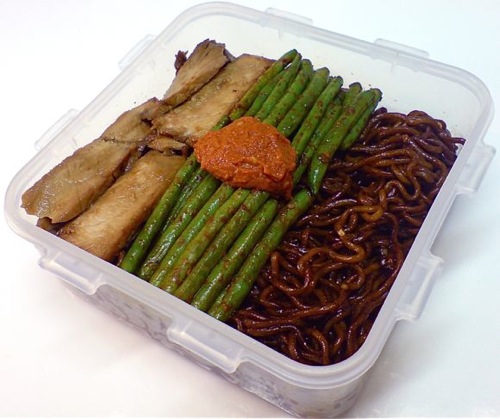
Char Siew & Kon Loh Meen Bento

charsiew bento
Today's bento is a Malaysian-style bento, containing Char Siew (Chinese barbecued pork) and Kon Loh Meen (soya sauce noodles), with haricot beans stir-fried in sambal belachan chilli. I've packed this bento in a microwavable container, as this dish tastes better warm.

Kon Loh Meen (lit. dry, mixed noodles) is a popular noodle dish in Malaysia, Singapore and Hong Kong. There are many variations, usually with some combination of garlic, oil, and soya sauce mixed together with cooked noodles. This is my mother's version, that she makes to accompany her homemade Char Siew (Chinese barbecued pork). Kon Loh Meen is usually made with thin egg noodles, but when I was young, we didn't have access to a large variety of Chinese noodles, hence my mother used instant noodles instead. Now, although I can easily buy thin egg noodles, I still like using instant noodles to make this dish - old habits die hard!

Continue reading...


Kon Loh Meen (Dry Soya Sauce noodles)
(serves 1)
1 packet instant noodles or thin egg noodles
3/4 Tbsp light soya sauce
3/4 Tbsp thick dark soya sauce
1 Tbsp garlic oil
dash of oyster sauce
dash of pepper
  1. Mix the soya sauces, garlic oil, oyster and pepper on a medium-sized plate.
  2. Boil some water in a saucepan, and add the noodles to the boiling water. Stir to loosen the noodles.
  3. When the noodles are cooked, drain, then immediately pour them onto the plate with the sauce. 
  4. Stir well to combine the noodles with the sauce. (You have to mix them immediately when the noodles are warm, or the sauce won't coat the noodles evenly.)
  5. Taste, and add more seasoning (soya sauce/oyster sauce/garlic oil) if required.
To make garlic oil:
Over low heat, fry some finely chopped garlic in light olive oil until the garlic is fragrant and golden (but not brown or burnt).

(It's handy to make extra garlic oil and keep it on hand to use for noodles or pasta)


Note: The thick, dark soya sauce is known as kicap pekat in Malaysia. It is a dark soya sauce, slightly thicker than the normal Chinese dark soya sauce, and a little sweet.

Serve these noodles with Char Siew (Chinese Barbecued Pork).

Back


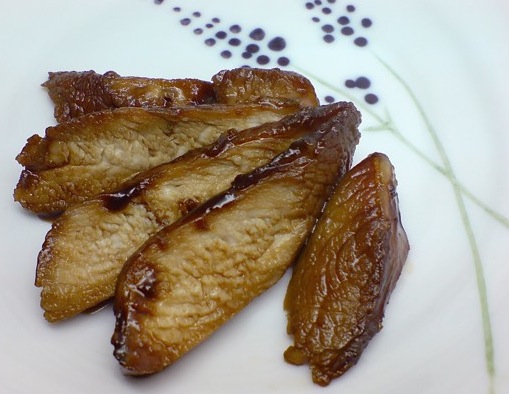
Homemade Char Siew (Chinese Barbecued Pork)

char siew

Char Siew (lit. fork roast) or Chinese barbecued pork, is a popular method of cooking pork in Hong Kong and Southeast Asia. Traditionally, long strips of marinated boneless pork are skewered with long forks (hence the name) and cooked in an oven or over a fire. This recipe is my mum's homemade version, and is based on the dark char siew common in Malaysia (as opposed to the red char siew version). It's very easy to make, and the taste is pretty authentic, especially taking into account how simple it is to prepare. 

Continue reading...


Homemade Char Siew (Chinese Barbecued Pork)
1/2 - 1 lb shoulder pork
1 Tbsp light soya sauce
1 Tbsp thick dark soya sauce
1 Tbsp oyster sauce
2 Tbsp honey or golden syrup
dash of pepper
  1. Trim any larger amounts of fat from the pork. Slice the pork into 1.5 - 2 inch strips.
  2. Mix the soya sauces, oyster sauce, honey and pepper together to form the marinade. (There is enough marinade for up to around 1 lb pork)
  3. Marinate the pork for 1 -2 hours.
  4. Heat up a non-stick pan/pot, and cook the strips of pork until cooked, basting frequently with the marinade. You can also grill the pork (basting frequently). 
  5. Slice and serve with rice or noodles.
Update: The thick dark soya sauce I use is Kicap Pekat, a Malaysian soya sauce that is thick and slightly sweet.


Thursday, August 21, 2008

Bak Kut Teh

bak kut teh
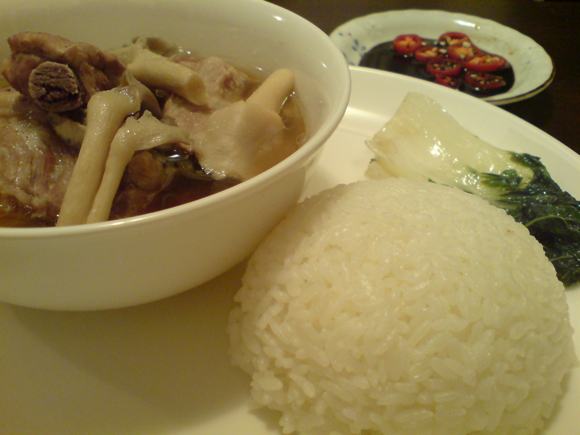
I didn't realise how much Singaporean/Malaysian food I actually make until I started posting on this blog. Here's last night's offering - Bak Kut Teh. Bak Kut Teh (which is Hokkien for "meat bone tea"), is a Chinese soup made out of various herbs and spices, boiled with pork ribs. If you're interested in reading more about this dish, Wikipedia has a good description here.

As with mostly everything I cook, this can be made really quickly - about 40 minutes, with most of that just boiling time. The one thing you will need, though, is a packet of Bak Kut Teh spices. Without it, it would just be too much work. You can find Bah Kut Teh spice packets in Singaporean and Malaysian supermarkets - check your local Chinese store in other countries to see if they stock it, too... 

Continue reading...


Just follow the instructions on your Bah Kut Teh spice pack. Mine were - boil 1.5L water, add pork ribs, 12 cloves garlic, few drops dark soya sauce and boil everything for 35 minutes. In the meantime, I prepared some rice in the rice cooker, and went about making preparations for the next day's bento lunch. 

Towards the end of the 35 mins cooking time, I added in some mushrooms and also some bak choy (chinese cabbage). Once the bak choy was tender, I scooped it out to serve separately. These added ingredients are optional - you can just leave it as is. Taste the soup and add more soya sauce and pepper if necessary. And that's pretty much it! Serve the Bak Kut Teh with rice, and some chopped fresh red chilli and dark soya sauce. 

Simple Rice Decoration - Mounds of Rice


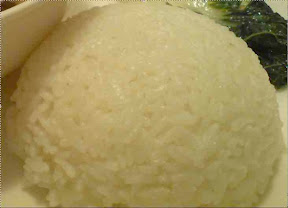
A fast, simple way of making a meal that includes rice look more fancy is to serve it moulded on your plate like they do in some restaurants. It makes the rice look so much better (compared to a heap of rice on a plate) and only adds a minute or so to prep time (and one more small bowl to wash up), that I usually make this effort.

Take a small bowl, wet it with water, then drain the water out (leaving a few drops inside the bowl), scoop cooked rice into the bowl (up to whatever height you wish) and press down gently but firmly to mould the rice into the shape of the bowl. Turn the bowl upside down onto a plate to unmould the rice, and serve. This works for all rice dishes including fried rice, coconut rice, etc.

Tips: If your mound of rice cracks a little on top, just use your rice scoop or a spoon to press it gently back together. Remember to wet the bowl a little before moulding each mound of rice. The water stops the rice from sticking to the bowl and helps it slide out. If your rice is too dry, the mound may fall apart. Try mixing your rice with a little warm water first to help it stick together.

Back


Tuesday, August 19, 2008

Bak Chor Mee

bak chor mee
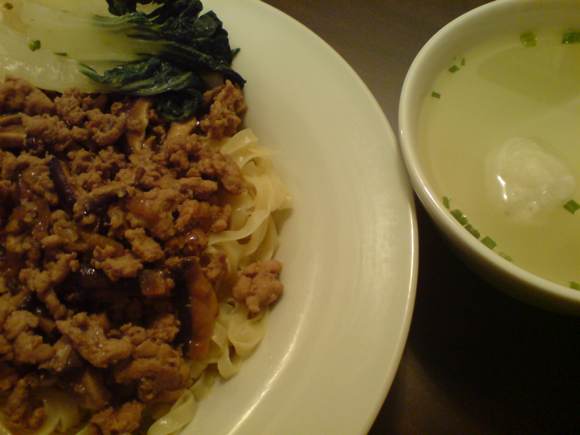
In an attempt to satisfy YH's mee pok craving, I tried to make Bak Chor Mee (the meat and mushroom version of mee pok). I couldn't find many recipes online, and since the last time I'd tasted this dish was many years ago, I had nothing much to go on except a vague memory and Wikipedia's description of mee pok and what ingredients were included. 

Continue reading...

Here's my version of Bak Chor Mee:

Mee pok noodles (or if you can't find them, you could use linguine)
Garlic (chopped finely)
Shallots (chopped)
Minced Pork
Shitake or Chinese Mushrooms, sliced (I couldn't find Shitake, so I used fresh Chinese Mushrooms)
Light Soya Sauce
Dark Soya Sauce (I used a thick dark soya sauce (Kecap Manis) for colour and flavour. I'm not sure if a Singaporean mee pok version would use this though - this is prob more of a Malaysian style)
Chinese Black Vinegar
Chilli Oil (or red pepper flakes)
Sambal Belachan Chilli
cooking oil (I use Light Olive Oil)

chopped red chilli and soy sauce (for dipping)

On low heat, lightly fry the garlic in a medium-sized saucepan with around 2 Tbsp oil until fragrant. (Don't let the garlic darken in colour or it will burn). Remove most of the garlic and oil onto a separate dish. Using the remainder garlic oil in the pot, turn up the heat to medium and add the chopped shallots. Fry, then add the minced pork. Continue to fry and mash the minced pork up so it doesn't clump together. Just before the meat is cooked through, add the mushrooms. Add some light soya sauce to stop the mixture from drying out. The mushrooms will also sweat out their liquids as they cook. Add a bit of chilli oil or red pepper flakes, and around 1 heaped tsp or more of Sambal Belachan Chilli (add more or less according to how spicy you want your noodles). Add the vinegar and some dark soya sauce (or Kecap Manis to taste). Turn off heat and set aside.

Boil a pot of water, add the mee pok, and stir. They will not take long to cook - you will see the noodles change colour slightly. Do a taste test to check if they are done - they should be springy, not mushy. Remove and drain, and rinse with water. If you are using linguine, cook in salted water according to the packet's instructions.

Mix the noodles with the set aside garlic and oil - I find this stops the noodles from drying out and makes it easier to mix it with the rest of the meat topping later.

Option 1: 
Heat up the meat mixture, divide the noodles on plates, and pour the heated meat mixture over the noodles. Serve with chopped red chilli and soya sauce, and some fishballs in clear soup.

I vaguely recall that this is how it is served at hawker stalls - you mix your topping into the noodles when it is served. However, I actually feel the second option is better, as it gives you a better control on the taste of the final dish.

Option 2:
Heat up the meat mixture, add the noodles, and mix together. Add more soya sauce, vinegar and chilli to taste. Serve with chopped red chili and soya sauce. 

Back