Showing posts with label chinese festivals. Show all posts

Tuesday, January 27, 2009

Year of the Ox - Burger

burger

Apologies for not posting in a while, I've just finished up a project I was working on, and that took up most of my time for the past few weeks. Happy Chinese New Year for those celebrating! The first day of Chinese New Year was on 26th Jan, and we've been enjoying our 3-day holiday here in Hong Kong. Many small shops and restaurants close at this time of the year, so I tend to go on a grocery shopping frenzy beforehand to stock up the kitchen. I've been cooking almost non-stop (or so it seems) the past few days, and I'm finally taking a break - until lunchtime.

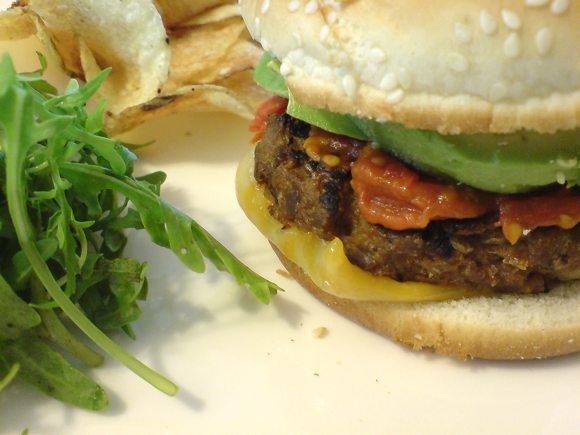
This year is the Year of the Ox, and although it was not planned, we ended up having (beef) burgers for lunch. I knew I would have a few days of cooking coming up, and some late nights, so I'd made the patties in advance and froze them. It made the world of difference in timing to simply defrost and re-heat the patties, and put together the rest of the burger. 

The recipe for my simple beef mince homemade burgers are here. If you are not raw onion eater (like me), or you don't like the taste of onion much, fry the onions first before adding them to the raw mince. That way, you can still have a medium-cooked burger, without the overpowering taste of semi-cooked onions. 

I topped the burgers with some avocado slices, mushrooms, melted cheese, and a homemade tomato sauce. This sauce is really quick and easy to make, and is a nice alternative to tomato slices (or store bought tomato ketchup) in your burgers. It can also be used as a dip for chicken nuggets, fish fingers, or as a topping for some pan fried seabass, etc.

Easy Homemade Tomato Sauce...


Easy Homemade Tomato Sauce
8 - 10 cherry tomatoes
1 Tbsp light olive oil
red pepper flakes (optional)
1. Slice the cherry tomatoes into quarters.
2. Heat up the oil in a small frying pan. Add the tomatoes and fry over medium high heat.
3. Squeeze the tomatoes with a spoon/spatula so their juices ooze out.
4. Add a few shakes of red pepper flakes if you like your sauce spicy (optional).
5. Continue frying until the tomato and their skins break down and the sauce thickens.


Back

Sunday, September 14, 2008

Mid-Autumn Festival Bento

moon bento
In the spirit of celebrating the Mid-Autumn Festival, I decided to make a bento dinner. The plan was to take our dinner to Victoria Park in Causeway Bay, one of the locations around HK where people gather with their children to carry lanterns. However, by the time I'd finished making the bentos, it was 8pm, I was exhausted and did not feel like stepping out the door. As YH had work to do, he was quite happy to stay home as well. 

Continue reading...

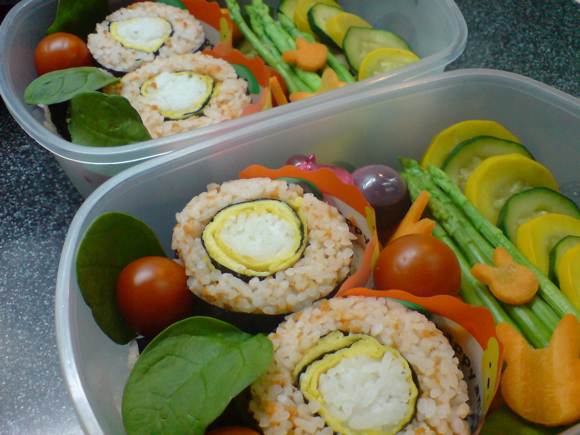
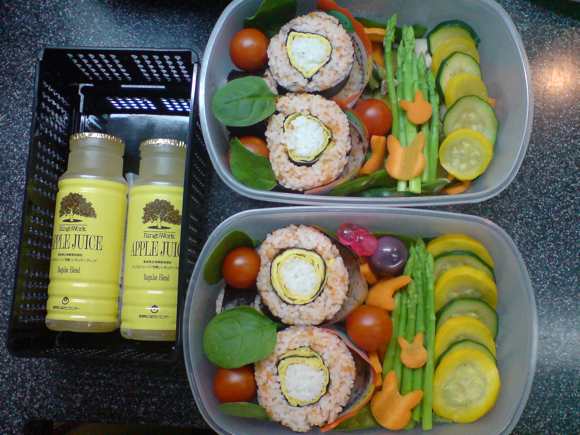
Despite it being a mid-autumn bento, which for me evokes images of pumpkins and orange-red leaves, the weather here in HK is still so warm that I decided to make sushi and salad. I rolled some maki (sushi rolls) with an egg and rice circle design to represent the full moon, and mixed salmon flakes with the rice for the outer circle to add colour and flavour.

The salad which accompanies the sushi celebrates the summer harvest. Yellow and green zucchini and snow peas were lightly stir-fried with sesame oil, then cooled, and mixed together with grilled chicken. I also added some ponzu (citrus soy vinegar) dressing in a little squeeze container, and topped the salad with some cherry tomatoes and rabbit-shaped carrots (to follow the Mid-Autumn Festival theme). All the colours put together ended up looking a little garish (also quite appropriate, I thought!)

Here are the completed dinner bentos, with some Japanese apple juice:
moon bento

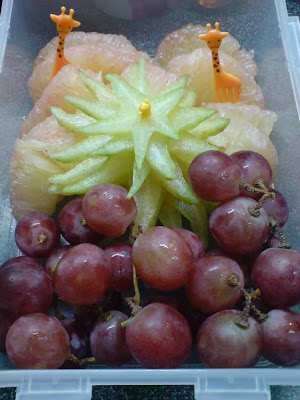
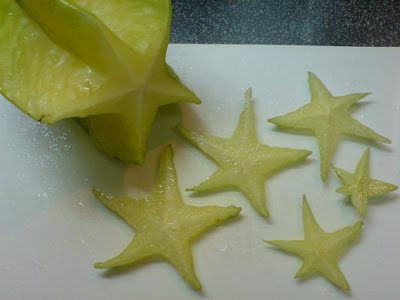
For dessert, I packed a separate fruit bento, with grapes, starfruit and pomelo.
fruits

The starfruit was a gift from a friend for the Mid-Autumn Festival. In Hong Kong, it is common for people to give each other fresh fruits or mooncakes during this time of year. The starfruit I received is one of the largest I've ever seen. It was around 20cm long. I've not eaten starfruit for a while although it is sometimes available in Hong Kong. Starfruit is very common in South East Asia, especially in Malaysia and Singapore, and is a little tart, juicy and very refreshing. (Apparently, starfuit isn't good for people with kidney problems, due to its high content of oxalic acid.)

starfruit

Back

Friday, September 12, 2008

Mooncakes & the Mid-Autumn Festival

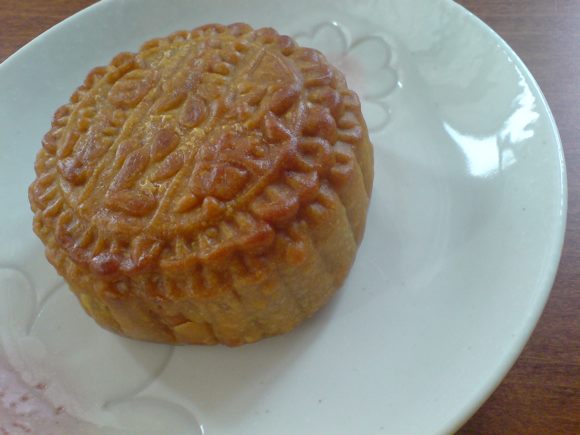
mooncake
This Sunday, 14th September 2008, is the Chinese Mid-Autumn Festival. As with most Chinese festivals, the Mid-Autumn Festival has been celebrated for thousands of years and has many myths and history associated with it. I grew up hearing different versions about a lady in the moon, a rabbit in the moon, messages in mooncakes, lanterns and revolts. As a child (and later as an adult!) I've paraded around holding colourful lanterns with lit candles inside them (how dangerous!) and watched my mother make home-made mooncakes. Now, I annually gorge myself silly on mooncakes, but I still only have a vague idea about what is actually being celebrated. So this year, I finally decided to do a bit of research...

The Mid-Autumn Festival is celebrated every year on the fifteenth day of the eighth month of the Chinese lunar calendar. It is also referred to as the Full Moon Festival or Mooncake Festival, and is one of the more major Chinese festivals. As its name suggests, it occurs exactly in the middle of autumn according to the lunar calendar (ie. autumn runs from the seventh to the ninth month, and mid-autumn is the fifteenth day of the eighth month) and corresponds to the autumn equinox. On this day, the moon's orbit is at the lowest angle to the horizon, which makes the moon appear larger and brighter than any other time of the year.

Continue reading...


What is actually celebrated?
Here's where things get a little hazy. The Festival probably had its origins in ancient China, when emperors (and then later, the common people) offered sacrifices to the sun in spring and the moon in autumn. Some say farmers celebrate the end of the summer harvest season on this day, and others worship the moon goddess. In today's context, the festival is a celebration of abundance and family (rather like American Thanksgiving), where families gather for dinner, mooncake is eaten and given to family and friends as gifts and children carry lanterns and parade around under the bright moon.

Myth of Chang'e
There are many different versions of a beautiful lady/goddess who lives on the moon, Chang'e (also Ch'ang-O, Chang-Ngo). Although the story changes greatly with each version (eg. she loves her husband/hates him, she steals an immortality elixir, or takes it so the enemy doesn't get his hands on it, etc.), all variations generally explain how Chang'e ends up taking an elixir/pill and floats up from earth to the moon. The different versions usually include mention of Houyi (the archer/hunter/husband), an emperor, an enemy and some elixir of life/immortality pill. Generally accepted is Chang'e's companion - an immortal rabbit who lives on the moon and mixes immortality elixirs.

The versions are all so different that it seems incomplete (and yet necessary) to mention just one (taken from Wikipedia). If you are interested, you can read some of the other versions here and here.
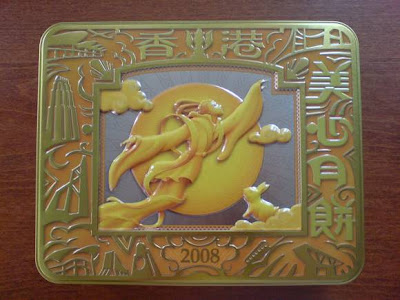
chang'e
Chang'e, a beautiful young girl working in the Jade Emperor's Palace, was married to an immortal, Houyi. One day Houyi was slandered by jealous immortals before the Jade Emperor, and he and Chang'e were banished from heaven and forced to live on earth. Houyi became a famous archer. At that time, there were 10 suns, but one day, all 10 suns circled together, causing the earth to burn. The Emperor of China commanded Houyi to shoot all but one sun down. When he had done this, the Emperor rewarded him with a pill of immortality and asked him to pray and fast for a year before taking it. Houyi returned home and hid the pill under a rafter. Chang'e, noticing a white light from the rafters, discovered the pill and swallowed it. She found she could fly. Houyi returned home at this time, started to scold her, so she flew out the window. Houyi chased her across the sky, but had to return to earth due to the force of the wind. Chang'e reached the moon, and as she was breathless, coughed. Part of the pill fell out of her mouth. She asked the rabbit who was on the moon to make another pill out of it so she could return to earth to her husband. Apparently, the rabbit is still pounding herbs, trying to make the pill. Houyi built a palace in the sun, and once a year, on the 15th day of the full moon, he visits his wife, which is why on that night, the moon is full and beautiful.

Mooncakes & History
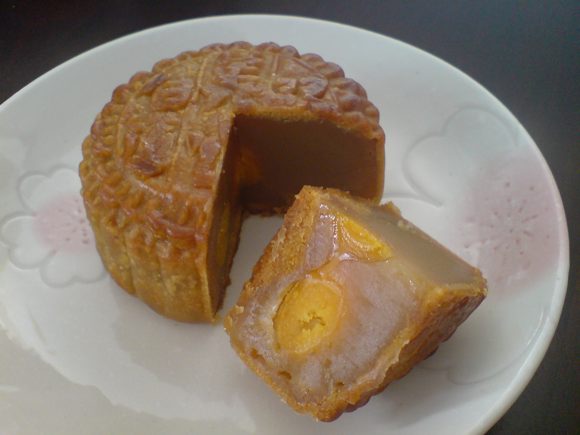
cut mooncake
The food most associated with the Mid-Autumn Festival is the mooncake (yuèbĭng "moon biscuit"). The mooncake is a round or rectangular Chinese pastry with a thin, sweet-oily dough crust and a thick sweet filling inside, traditionally made out of lotus seed paste. A standard size mooncake is around 8 - 10cm in diameter and 4 cm thick. As mooncakes are very rich and dense, people usually cut them into smaller wedges to share and eat. Smaller, mini sized mooncakes are also sometimes available.

Many mooncakes contain a whole, salted egg yolk inside, which represents the full moon. You can also find mooncakes with no yolk, 2 or 4 yolks inside. Crusts can be chewy, flaky, or tender according to regional preferences and are often imprinted with a design, such as the Chinese character for "longevity", "harmony" or the name of the store that made them. As making a mooncake is quite a labour intensive process, people seldom make their own.

There are now many different mooncake fillings available, from the more traditional yellow or white lotus seed paste, to red bean paste, mung bean paste, and yam paste. With the advent of the unbaked snow-skin mooncake (made from glutinous rice flour, sugar and shortening) and jelly mooncakes, the range of fillings available exploded and includes everything from ice-cream to durian, jackfruit, chocolate, coffee, green tea and birds nest flavoured pastes. 
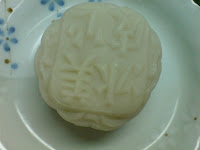

snowskin mooncake
A milk-tea flavoured snow-skin mooncake.


Also associated with the mooncake is the story of how they were used in a rebellion in the 14th century during the Yuan dynasty, when the Mongolians were ruling China. Apparently, the Chinese hid messages inside each mooncake and distributed it to coordinate a rebellion. Thus, they managed to drive out the Mongolians and the Ming Dynasty was established. Regardless or whether it is true or not, it makes for a nice story, and something to discuss as you eat your mooncake!

Back